A practical guide to RAG: grounding LLMs in your own data
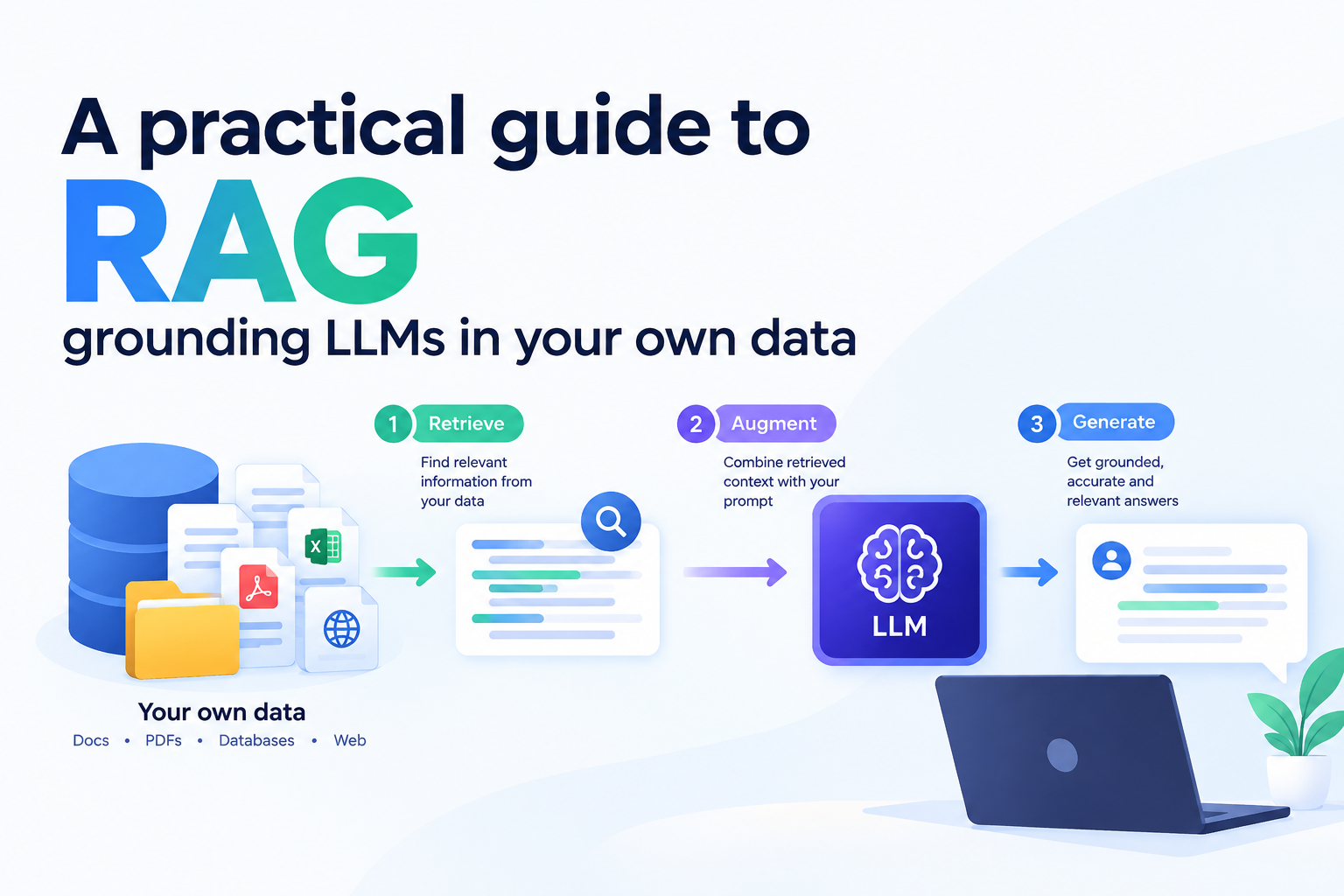
Large language models are powerful, but on their own they only know what they were trained on — and they’ll happily invent answers when they don’t. Retrieval-augmented generation (RAG) fixes that by giving the model your data at question time.
Why RAG instead of fine-tuning?
Fine-tuning bakes knowledge into the model’s weights — expensive, slow to update, and hard to audit. RAG keeps your knowledge in a searchable store and feeds only the relevant passages into each prompt. The result is accurate, current and explainable answers.
- Fresh — update a document, and the next answer reflects it instantly.
- Grounded — every response can cite the source it came from.
- Cheaper — no retraining cycles; you pay for retrieval and inference.
The core pipeline
- Ingest your documents and split them into clean, overlapping chunks.
- Embed each chunk into a vector and store it in a vector database.
- Retrieve the most relevant chunks for a user’s question.
- Augment the prompt with those chunks and generate the answer.
Getting it right in production
The demo is easy; the production system is where teams struggle. Watch for chunking strategy, retrieval quality, prompt budgets, and evaluation. Measure answer quality with a real test set before you ship — and keep a human in the loop for high-stakes use.
Done well, RAG turns a generic chatbot into an assistant that actually knows your business. That’s the difference between a demo and a product.